Dive into the temporal accumulation logic and ML kernels of PSSR 2.0. Learn how the PS5 Pro’s AI accelerators fix shimmering and compete with DLSS 4.
If you’ve been following the console-vs-PC debate for a while, you already know it used to come down to one word: teraflops. More power, better games. Simple enough. But with the arrival of PSSR 2.0 in March 2026, that conversation has quietly shifted into much deeper territory — we’re talking neural kernels, temporal accumulation, and dedicated AI silicon. It sounds complex, but once you understand what’s actually going on under the hood, the experience on screen starts to make a lot more sense.
Why Your PS5 Pro Games Look So… Calm
There’s a specific visual problem that has haunted upscaling technology for years. If you’ve ever noticed a fine chain-link fence flickering in the background, or sunlit leaves on a tree seeming to crawl and shimmer as your camera moves, you’ve seen temporal instability up close. It’s distracting, and it’s been stubbornly difficult to fix.
Early solutions like FSR 2 and the original PSSR handled this by blending previous frames with the current one using motion vectors — essentially an educated guess about where each pixel came from. It worked well enough, but the guesswork showed.
PSSR 2.0 throws that approach out entirely. Instead of heuristics, it uses machine learning kernels — small neural networks that analyze sub-pixel movement and predict, with remarkable precision, where a pixel should have been in the frame before this one. When the AI spots a high-frequency detail like a strand of hair or a woven texture, it increases the temporal weight of that area. In plain terms, it locks those pixels in place across frames so they stop flickering. The “crawling” effect disappears because the algorithm is no longer undecided — it knows what color that pixel should be.
The Hardware That Makes It Possible
None of this would work on a standard PS5. The reason PSSR 2.0 exists at all is because Sony built dedicated AI accelerators directly into the PS5 Pro’s APU. These aren’t just extra GPU cores — they’re specialized blocks designed specifically for the INT8 and FP16 operations that neural networks rely on.
Because these accelerators sit right on the silicon die alongside the main compute units, the entire process of upscaling an image from 1080p to 4K costs less than 2 milliseconds. More importantly, by handing the neural workload off to dedicated hardware, the main GPU is free to focus on ray tracing and geometry without breaking a sweat. That’s why PSSR 2.0 doesn’t come with the performance penalty you might expect from something this sophisticated.
How It Stacks Up Against DLSS 4
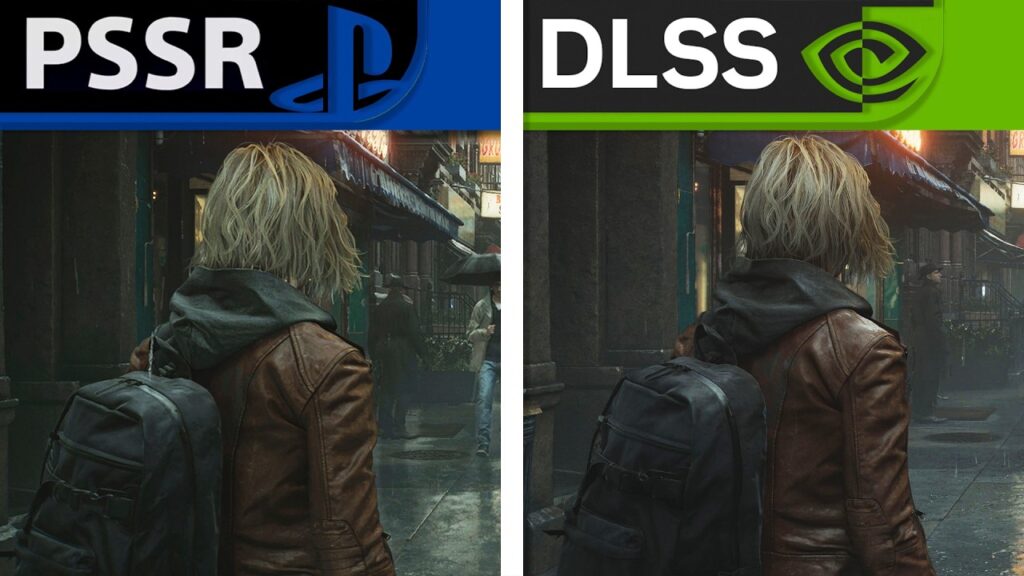
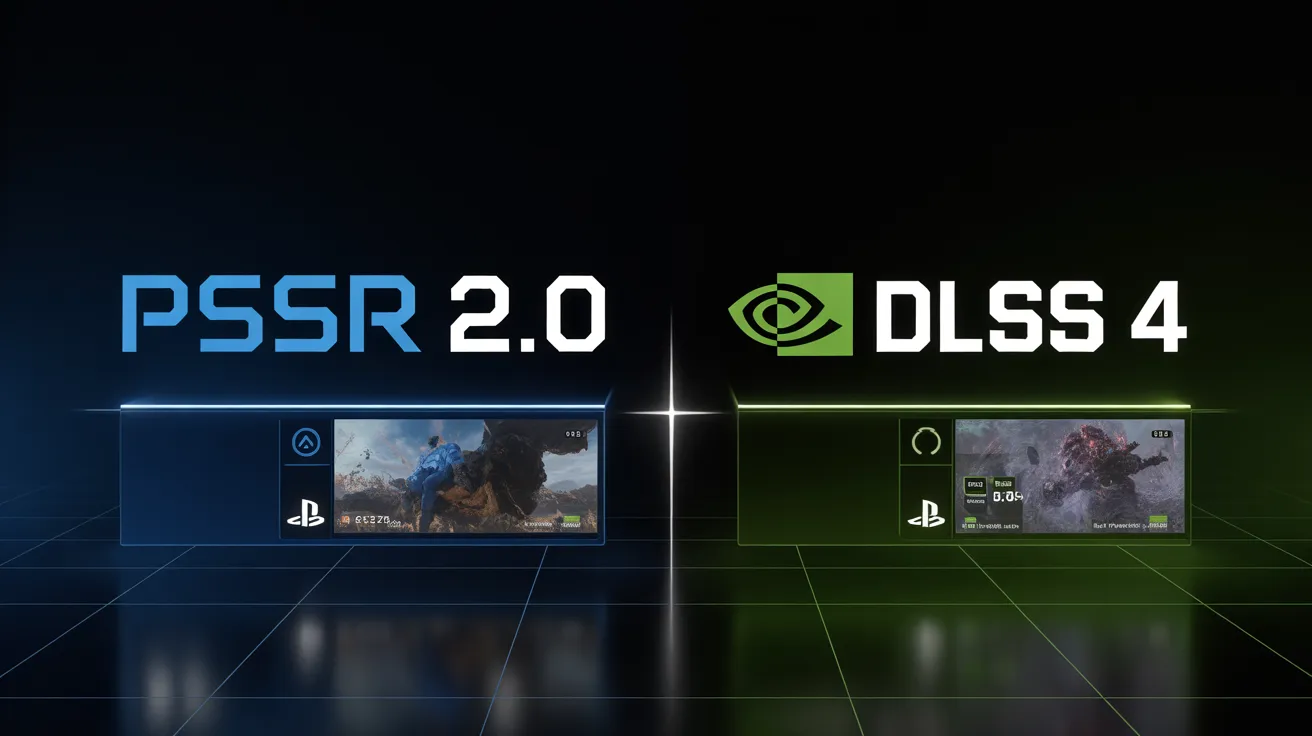
NVIDIA’s DLSS 4 takes a different philosophical approach, and comparing the two reveals just how varied AI upscaling has become.
PSSR 2.0 is built on a CNN-based (Convolutional Neural Network) model and uses a hybrid logarithmic math space with heavy temporal weighting to keep images stable. DLSS 4, by contrast, uses a Vision Transformer model — a newer architecture borrowed from the world of language AI — and operates in linear space, working directly with raw light data rather than a processed version of it.
That linear space approach is arguably DLSS 4’s biggest advantage. Most upscalers process images in logarithmic space because it softens instability and makes flickering easier to suppress. The downside is that it can subtly crush shadow detail or flatten vivid highlights. DLSS 4’s transformer model is powerful enough to handle raw linear data without it degenerating into noise — something earlier architectures simply couldn’t manage. PSSR 2.0 has made real progress here, but it still leans on its temporal weighting to stay stable rather than trusting the raw data outright.
Why Clarity Matters More Than Resolution Now
Here’s the interesting place we’ve arrived at in 2026: resolution itself isn’t really the bottleneck anymore. A game running at 60fps on a PS5 Pro with PSSR 2.0 active can genuinely look sharper than a native 4K image, because the AI is continuously cleaning up the noise and edge aliasing that any game engine naturally produces. The image isn’t just bigger — it’s actively being refined, frame by frame.
Sony’s “Enhance PSSR Image Quality” toggle takes this a step further. It allows the console to intercept older PSSR 1.0 calls from legacy games and quietly replace them with the new ML kernels at the operating system level. It’s not a patch in the traditional sense. It’s the hardware re-learning how to interpret light — and for players, the result is a stillness on screen that, once you notice it, you can’t unsee.