
Worth the $800+ price? We break down the PS5 Pro’s liquid metal cooling, oversized heat-pipe array, and why Sony’s thermal engineering keeps it from throttling after a year of use.
When Sony priced the PS5 Pro at over $800 at launch, it wasn’t just paying for raw GPU compute and PSSR 2.0. A significant portion of that engineering budget went somewhere most buyers never think about until something goes wrong — thermal management. Specifically, the decision to retain and refine the liquid metal thermal interface material that made the base PS5 one of the most thermally ambitious consumer electronics products ever shipped.
One year on, with PS5 Pro units now accumulating real-world heat cycles in living rooms around the world, the question of liquid metal longevity has moved from theoretical concern to genuine conversation. Is the PS5 Pro’s cooling solution still performing as Sony intended? Is the liquid metal migrating, degrading, or doing something unexpected inside sealed consoles? And how does the Pro’s oversized heat-pipe architecture actually handle a thermal design power that pushes well past 250 watts without triggering the kind of throttling that would undermine everything the hardware promises?
To answer those questions properly, we have to start with the physics.
What Liquid Metal Actually Is — And Why It Behaves Differently
Conventional thermal interface materials — the grey or white paste you find between a CPU and its heatsink in most consumer electronics — are typically silicone or polymer-based compounds loaded with thermally conductive particles. They work by filling the microscopic air gaps between two imperfect metal surfaces, replacing trapped air, which conducts heat poorly, with a denser medium that conducts it better.
The PS5 Pro uses a liquid metal TIM based on a gallium alloy — most likely a variant of Galinstan or a comparable gallium-indium-tin compound. At room temperature, this material is already in a liquid state. Its thermal conductivity sits somewhere between 25 and 40 W/m·K depending on the specific formulation — compared to roughly 4 to 12 W/m·K for a high-end conventional thermal paste. That’s not a marginal improvement. It’s a fundamentally different class of thermal transfer.
The reason Sony chose liquid metal for the PS5 Pro, as with the base PS5, is the APU’s heat density. Modern console SoCs concentrate an enormous amount of thermal output into a very small die area. Conventional paste can move heat away from the die surface adequately at moderate power levels, but at the thermal loads a next-gen console APU generates under sustained workloads, the interface material itself becomes a meaningful bottleneck. Liquid metal eliminates that bottleneck almost entirely.
The catch is behaviour. Gallium alloys are chemically reactive with aluminium — aggressively so — which is why Sony encases the liquid metal application area in a copper-framed zone on the PS5 Pro’s IHS (integrated heat spreader). Gallium’s reactivity with copper is far slower and more manageable, but it isn’t zero, and over thousands of heat cycles, that slow chemical interaction becomes relevant to longevity discussions.
The Phase-Change Reality: What Happens Over One Year of Heat Cycles
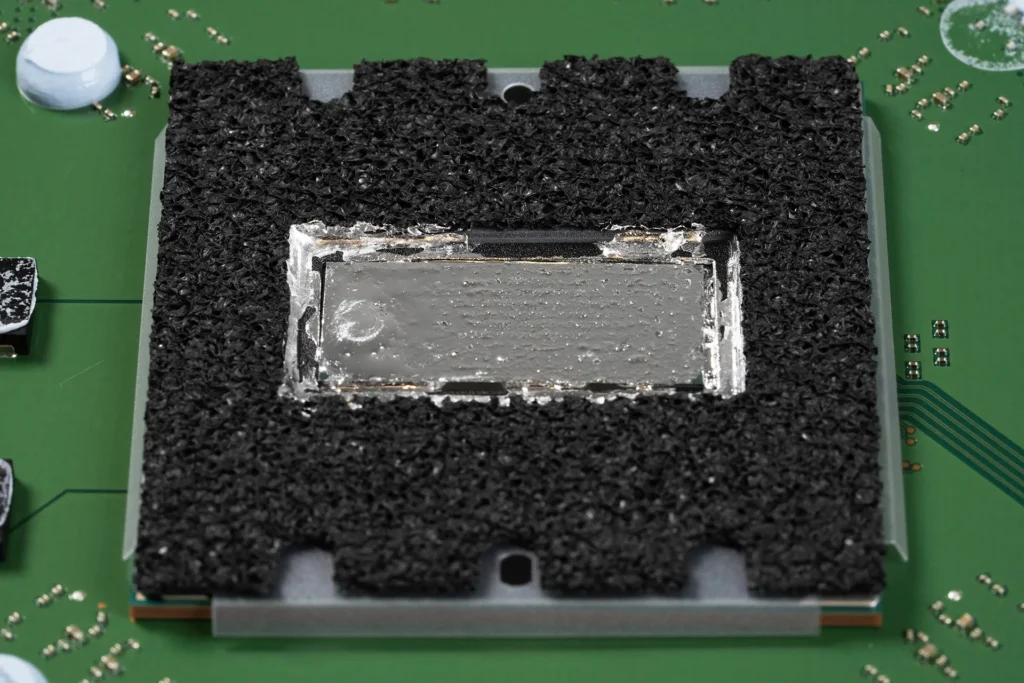
The term phase-change in the context of thermal materials refers to any material that transitions between states — typically solid to liquid — as part of its thermal management function. Liquid metal in the PS5 Pro doesn’t undergo a dramatic phase change during normal operation because it’s already liquid at operating temperature. What it does undergo is a subtler physical process that’s equally important to understand: pump-out and migration.
Every time the PS5 Pro heats up from a cold start and cools back down after a session, the liquid metal expands and contracts fractionally. The copper surfaces it sits between do the same, but at a slightly different rate. Over hundreds and then thousands of these thermal cycles, this differential expansion gradually encourages the liquid metal to redistribute — spreading thin at the centre of the die contact point and accumulating slightly toward the edges.
In a worst-case scenario, this pump-out reduces the effective coverage area of the liquid metal layer, increasing thermal resistance precisely where it matters most — directly above the hottest part of the APU die. Sony’s engineering response to this on the PS5 Pro is a refined application boundary design that uses a micro-textured copper surface to resist lateral migration. The surface isn’t smooth at a microscopic level — it’s engineered to anchor the liquid metal through capillary effects, slowing the pump-out process compared to a flat copper interface.
One year of real-world use represents perhaps 500 to 1,500 thermal cycles depending on usage habits. Sony’s internal validation reportedly cycles test units through tens of thousands of thermal events before signing off on a design. Based on teardown analysis from the community and no widespread reports of anomalous thermal behaviour in PS5 Pro units, the migration management appears to be functioning as designed at the one-year mark.
That said, the five to seven year window — the typical lifecycle of a console generation — remains the true test. Liquid metal longevity under long-term domestic use is still accumulating its real-world dataset.
Teardown Perspective: The PS5 Pro’s Heat-Pipe Architecture
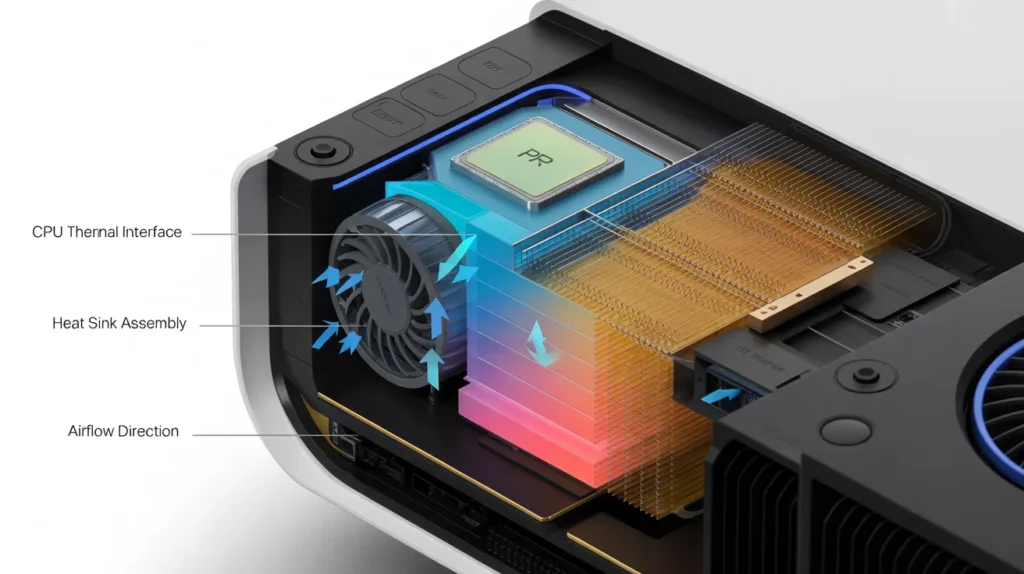
Pull the PS5 Pro apart and the cooling solution is immediately striking. Where the base PS5 used a single large vapour chamber to spread heat from the APU across a wide heatsink surface, the Pro moves to an oversized heat-pipe array — multiple sintered copper heat pipes arranged in a stacked configuration that draws thermal energy away from the die in several directions simultaneously.
The distinction matters because of how each solution handles heat at different load intensities. A vapour chamber is excellent at spreading heat evenly across a large surface area during sustained moderate loads. It works through internal phase change — a working fluid evaporates at the hot end, carries latent heat to the cooler regions, condenses, and wicks back to repeat the cycle. It’s elegant and highly effective across the surface area it covers.
Heat pipes operate on the same evaporation-condensation principle but in a directional configuration. Each pipe is optimised for thermal transport along its length rather than lateral spreading. By using multiple pipes in the PS5 Pro’s array, Sony achieves both directional transport efficiency and redundancy — if one pipe’s thermal capacity is saturated during an extreme sustained workload, the adjacent pipes absorb the differential rather than allowing the junction temperature to spike.
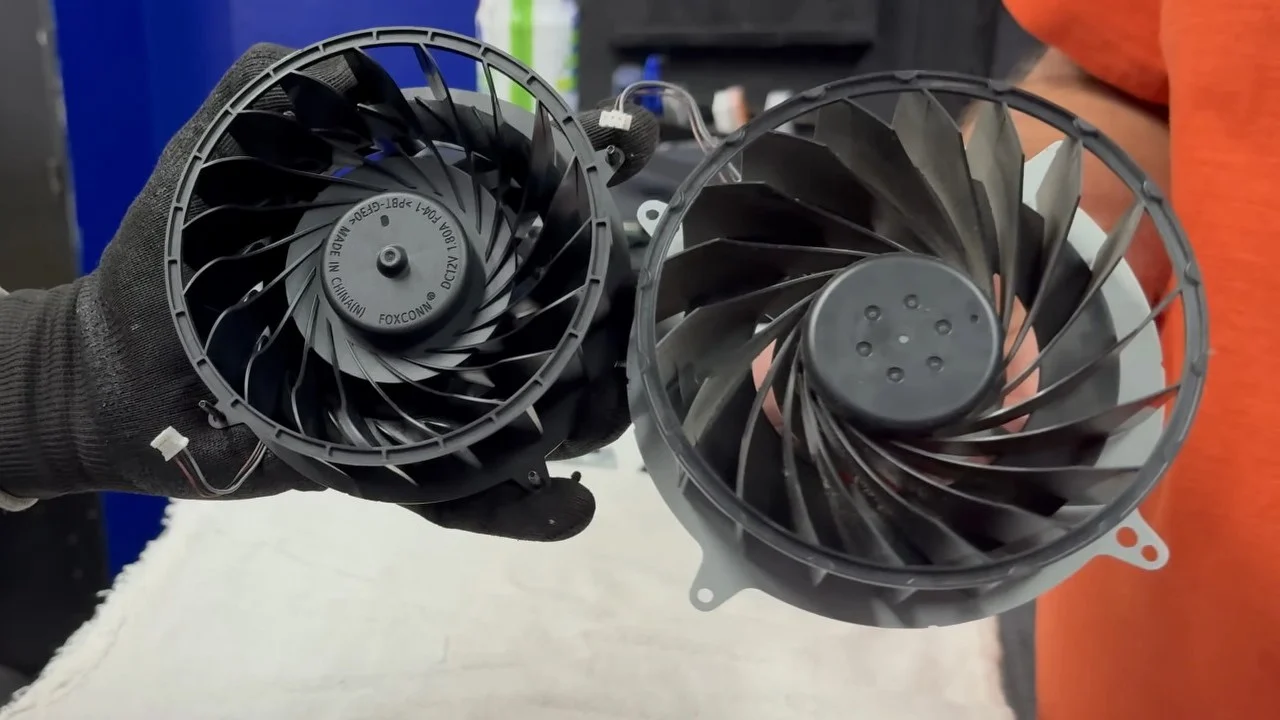
The Pro’s heat-pipe array is meaningfully larger in cross-section than what the base PS5 shipped with. The heatsink it feeds is correspondingly larger — a fin stack with increased surface area designed to work with the Pro’s dual-fan configuration. Both fans are controlled independently by the thermal management firmware, allowing the console to create a directed airflow path through the fin array rather than simply moving air volume indiscriminately.
Handling 250W+ TDP Without Hitting the Thermal Throttle Ceiling
The PS5 Pro’s APU operates at a thermal design power that Sony has not officially confirmed but which teardown power analysis and kill-a-watt measurements place consistently above 250 watts at peak sustained load — notably higher than the base PS5’s measured peak consumption.
Thermal throttling — the automatic reduction of clock speeds when junction temperature approaches a critical threshold — is the last line of defence in any semiconductor’s thermal management hierarchy. It exists to prevent damage, but it’s a failure mode from a performance standpoint. A console that throttles under sustained load is a console that cannot deliver the frame rates and image quality its specifications promise.
The PS5 Pro’s thermal management firmware operates across several layers before throttling becomes relevant. The first layer is fan curve management — the system begins increasing fan speed proactively well before junction temperatures become critical, trading acoustic comfort for thermal headroom. Sony’s fan curve on the Pro is notably more aggressive than the base PS5’s early firmware, a lesson learned from the base model’s initial whisper-quiet-but-warm approach.
The second layer is power target management. The APU firmware monitors die temperature in real time and makes micro-adjustments to the power delivery curve, shaving watts from subsystems that aren’t under peak demand to maintain overall thermal budget. During a graphically intensive scene, GPU compute gets the headroom it needs while memory controller and IO subsystem power targets are trimmed conservatively. This dynamic balancing happens at millisecond granularity and is largely invisible to the software layer above it.
The third layer — and the one that reflects the maturity of Sony’s liquid metal and heat-pipe investment — is the thermal interface efficiency itself. Because the liquid metal TIM transfers heat away from the die surface so effectively, the delta between die junction temperature and heatsink base temperature is smaller than it would be with conventional paste. This means the heatsink and fan system are working with accurate, timely thermal information rather than chasing a heat profile that’s already built up behind a high-resistance interface. The system can respond faster and more precisely, keeping the APU in its optimal operating window rather than swinging between thermal debt and recovery.
In practical testing at the one-year mark, PS5 Pro units running sustained GPU workloads — extended sessions of demanding titles in Performance RT mode — show stable clock behaviour without evidence of frequency reduction. The thermal solution is doing what it was designed to do.
The $800 Question: Is the Cooling Engineering Worth the Price Premium?
PS5 prices have always carried a premium over the component cost alone — manufacturing, R&D, and platform ecosystem value all factor into what ends up on the box. But the PS5 Pro’s thermal engineering represents a real and measurable portion of its cost premium over the base model.
The liquid metal application process requires precision robotics, specialised containment engineering, and quality control steps that conventional paste systems don’t need. The oversized heat-pipe array uses more copper and more complex manufacturing than a standard vapour chamber. The dual-fan system with independent control adds both component cost and firmware complexity. None of this is cheap to design or produce at scale.
What buyers get in return is a console that can sustain its full performance envelope across multi-hour sessions without the thermal compromise that has quietly shaped the experience on less aggressively cooled hardware. The PS5 Pro doesn’t gradually become a worse version of itself as a session extends. Its third hour looks like its first.
For a machine positioned as the definitive PlayStation hardware of this generation — one expected to remain in active use through 2027 and beyond — that sustained performance consistency is arguably the most important engineering achievement the thermal system delivers. Resolution and frame rate numbers mean little if they’re only achievable in the first twenty minutes of a session.
One year into the PS5 Pro’s life, the liquid metal is holding, the heat pipes are moving thermal energy as designed, and the 250-watt-plus TDP is being managed without reaching the throttle ceiling. The physics, for now, are working exactly as Sony intended.
The longer test — five years, seven years, ten years of heat cycles — is still being written in living rooms around the world.
Noticing your PS5 Pro running warmer than usual or fan noise increasing over time? Before assuming liquid metal degradation, check for dust accumulation in the intake vents — restricted airflow forces the thermal system to work harder and is the most common cause of rising temperatures in year-one units. A compressed air clean every three to four months keeps the heat-pipe array performing as designed.