Hi, I’m Oliver, the person behind TechRebot. I’m passionate about exploring new technology, AI tools, and digital trends that are shaping the future. Through TechRebot, I share simple, easy-to-understand insights to help readers discover useful tools, understand emerging tech, and stay updated in this fast-moving digital world.
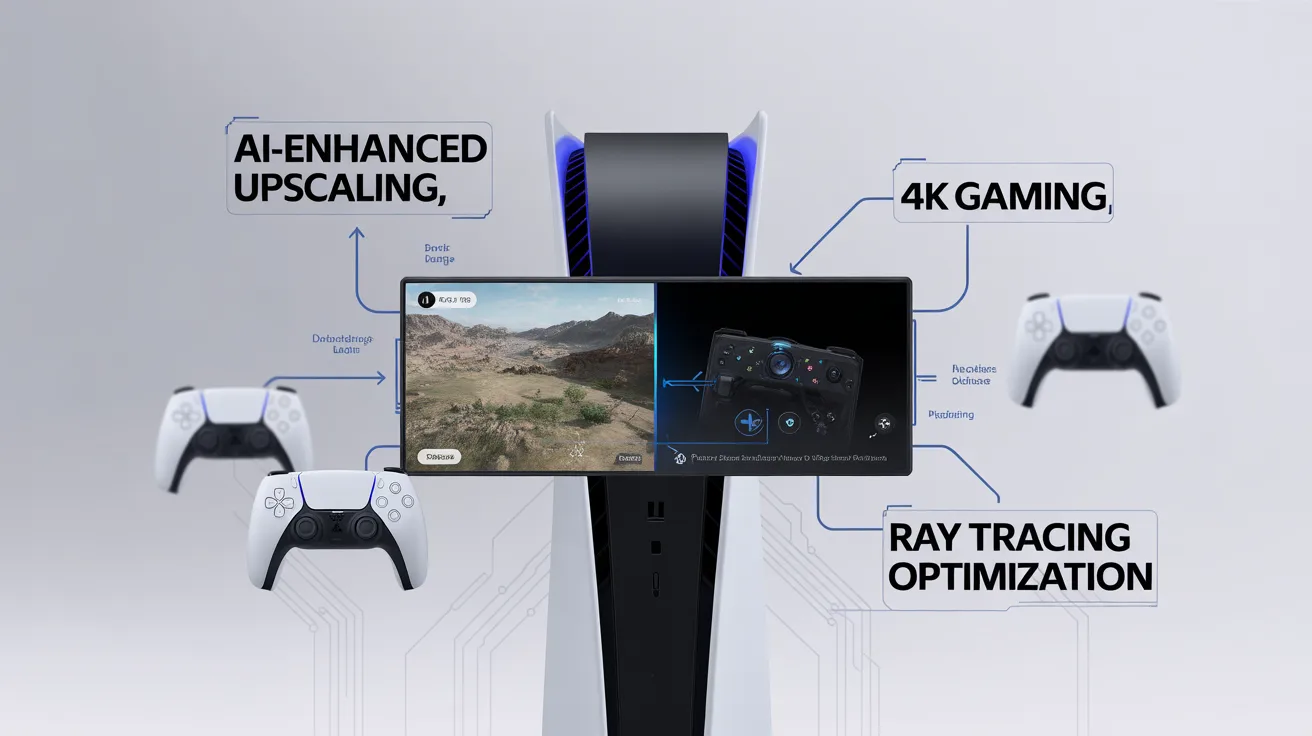
PS5 Pro PSSR Explained: How Sony’s AI Upscaling Technology Works
Sick of blurry games? The 2026 PSSR update uses AI physics to kill “visual foam” and flickering grass. Get the grit on how the PS5 Pro keeps your 4K 60FPS sharp.
To understand PlayStation Spectral Super Resolution (PSSR) in 2026, you have to look past the marketing “4K” labels and into the actual math of how it handles the “foam”—the visual noise, ghosting, and temporal instability that plagues traditional upscaling.
In the 2026 PSSR 2.0 update, Sony shifted from basic spatial upscaling to a high-density Hybrid CNN-Transformer architecture. Here is the technical grit of how it works.
1. The Physics of the “Foam” (The Artifacts)
In traditional upscalers (like FSR 2), the “foam” is a byproduct of Temporal Aliasing. When a game renders at a low internal resolution (e.g., 1080p) to save GPU cycles, it lacks the sub-pixel data needed for a 4K output.
The Compression: When you “stretch” that 1080p frame, the edges become pressurized and “pop,” creating jagged stair-stepping.
The Motion Leak: As objects move, the previous frame’s data “leaks” into the current one, causing Ghosting.
The Pulse: Ray-traced lighting often produces “stochastic noise” (grainy dots). Upscalers often misinterpret this noise as actual geometry, leading to a distracting “pulsing” effect in shadows.
2. The Reconstructive “Grit” (The AI Solution)
PSSR 2.0 doesn’t just guess pixels; it uses the PS5 Pro’s custom 300 TOPS (INT8) machine learning hardware to execute two distinct neural layers:
The CNN Layer (Local Feature Extraction): A Convolutional Neural Network analyzes small patches of the image to find edges, textures, and fine lines (like individual strands of hair in Resident Evil Requiem). It handles the “low-level” physics of the image.
The Transformer Layer (Global Context): Borrowed from LLM architecture, the Transformer looks at the entire frame simultaneously. It understands that a pixel in the top-left corner is related to a light source in the bottom-right. This prevents the “pulsing” artifacts because the AI knows the noise is a lighting property, not a solid object.
3. The “Why” Behind the Hardware: INT8 vs. FP8
The “why” of PSSR’s performance lies in its math. While PC-based upscalers like DLSS often use FP8 (Floating Point), the PS5 Pro is optimized for INT8 (8-bit Integer).
Efficiency: INT8 operations are mechanically “lighter” and faster for the PS5 Pro’s silicon to crunch.
Precision: By using Project Amethyst (the Sony-AMD collaboration), they’ve trained the model to maintain the precision of floating-point math within an integer pipeline. This is why PSSR 2.0 can upscale from a “low-pressure” 864p base to a stable 4K without the image collapsing into a blurry mess.
4. Real-World Performance: The 60FPS Barrier
For 2026’s heavy hitters like GTA VI, PSSR is the primary engine for achieving a “Performance Mode.”
The GPU Load: PSSR offloads the resolution work. Instead of the GPU struggling to push 8 million pixels (4K) at 60fps, it only pushes 2 million (1080p). PSSR handles the rest in the final milliseconds of the frame cycle.
The CPU Constraint: PSSR is a GPU-side solution. It does not solve CPU bottlenecks. If a game’s physics or AI (like GTA VI‘s dense crowd systems) maxes out the Zen 2 processor, no amount of AI upscaling will push the frame rate from 30 to 60.