Can the Xbox Series S keep up with next-gen only titles in 2026? We decode the 8GB bandwidth wall, aggressive texture streaming, and the micro-stutter problem nobody’s fixing.

There’s a conversation happening quietly across game development studios in 2026, and it’s increasingly uncomfortable for Microsoft. As the industry edges toward a generation of titles that were designed from the ground up for high-bandwidth memory and complex asset streaming, one piece of hardware keeps coming up in the same breath as words like “constraint,” “floor,” and “compromise.” The Xbox Series S — once positioned as the affordable gateway to next-gen gaming — is running into a wall that no software patch or developer workaround can fully dismantle. That wall is made of RAM.
To understand why the Series S memory architecture is becoming a genuine late-gen problem, you have to look past clock speeds and teraflops and examine how modern game engines actually use memory — and what happens when there isn’t enough of it in the right place at the right time.
The Split That Defines Everything
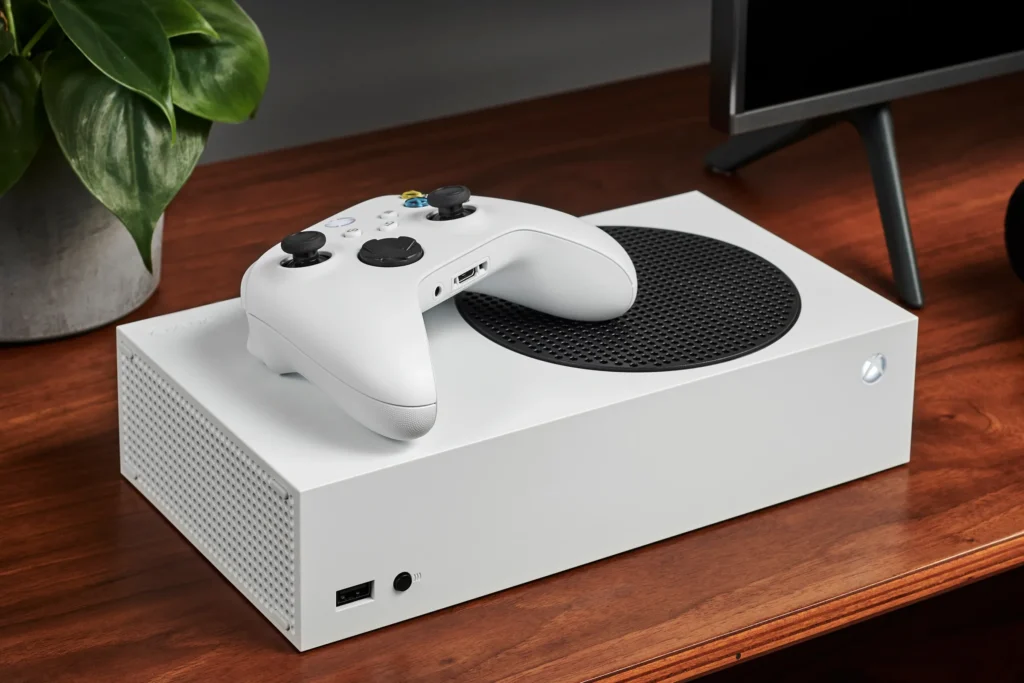
The Xbox Series S ships with 10GB of total RAM. On paper, that sounds adequate for a console targeting 1080p to 1440p output. In practice, the architecture of that memory is where the tension lives.
Of the 10GB, 8GB runs at 224GB/s — fast enough to handle active game data, rendering buffers, and the assets the engine needs right now. The remaining 2GB operates at 56GB/s, a dramatically lower bandwidth tier reserved for background tasks, OS overhead, and lower-priority data. Developers essentially have two pools of memory with a steep speed cliff between them, and the game engine has to make constant, real-time decisions about which assets deserve the fast lane and which can wait in slower storage.
On the Xbox Series X, developers work with 10GB at 560GB/s and 6GB at 336GB/s — a total of 16GB with far less variance between the two tiers. The PlayStation 5 offers a unified 16GB pool at 448GB/s with no tiered penalty at all. The Series S isn’t just working with less total memory — it’s working with a more constrained architecture at a moment in the generation cycle when game engines are actively designed to use as much high-bandwidth memory as they can get.
What Memory Pressure Actually Means in 2026
Memory pressure is what happens when a game engine needs more active data than the fast memory pool can hold. It’s not a crash. It’s not a hard failure. It’s a cascade of compromises that the engine makes automatically, and most players experience those compromises as visual or performance inconsistencies without ever knowing the underlying cause.
When the Series S runs a late-gen title pushing complex geometry, high-resolution texture sets, and real-time lighting data, the engine’s streaming system faces a choice every few milliseconds: what stays in the 8GB fast pool, and what gets pushed to slower storage or the lower-bandwidth memory tier? The assets that get demoted — typically textures, shadow maps, or pre-computed lighting data — have to be streamed back in the moment they become relevant again. If that streaming can’t keep pace with where the player is looking or moving, the engine either holds a lower-quality version of the asset on screen longer than intended, or it drops rendering quality dynamically to buy time.
This is why Xbox Series S versions of demanding multiplatform games in 2026 frequently show texture pop-in that isn’t present on Series X or PS5. It’s not a developer oversight. It’s memory pressure expressing itself visually.
Aggressive Texture Streaming: The Developer’s Coping Mechanism
When developers build for a platform with a constrained memory budget, they reach for a set of techniques collectively described as aggressive texture streaming. The core idea is to load only the highest-quality version of a texture at the precise moment it’s needed, discarding it again as soon as possible to free memory for whatever comes next.
In a well-implemented streaming system on a memory-rich platform, this process is essentially invisible. Assets load fast enough and memory is deep enough that the player never perceives the loading happening in the background. On the Series S in 2026, the same technique is doing considerably heavier lifting.
The high-speed 8GB pool fills quickly on modern titles with large, detailed environments. Once full, the streaming system has to make increasingly aggressive trade-offs. Textures are loaded at lower mip levels — essentially reduced-resolution versions — until the engine is confident the player is close enough to an object to justify the full-quality load. Environmental detail in mid-range distances, the kind of visual density that makes open-world games feel genuinely alive, is often the first casualty of an over-pressured texture streaming pipeline.
The practical result is a game that looks noticeably softer in motion than the same title running on hardware with a deeper memory pool, even when running at a technically equivalent resolution.
Resolution Scaling and the VRAM Swap Problem
Texture streaming isn’t the only tool developers use to manage memory pressure on the Series S. Resolution scaling — dynamically lowering the rendered resolution during intensive scenes and reconstructing it for output — has become a near-universal technique on the platform for exactly this reason.
When the memory pool is under heavy load, reducing the render resolution directly reduces the size of the framebuffer and associated rendering targets sitting in fast memory. A game rendering at 900p internally instead of 1080p frees meaningful amounts of high-bandwidth memory that the engine can redirect toward keeping active textures and geometry data resident. The output image is then upscaled to the display resolution, which partially masks the reduction in raw pixel count but cannot fully recover the detail that wasn’t rendered in the first place.
The deeper problem in 2026 is what developers are calling VRAM swap pressure — a situation where the engine is not just managing which textures sit in fast memory, but actively swapping data between the fast pool, the slow 2GB tier, and the console’s SSD storage in real time. Each swap carries a latency cost. When those swaps happen frequently enough, they introduce micro-stutters — brief, irregular frame time spikes that feel worse subjectively than a consistent lower frame rate because the human visual system is acutely sensitive to unexpected timing breaks.
The Series S SSD is fast by the standards of its launch year. But no storage solution eliminates the latency cost of a memory swap that a deeper RAM pool would have avoided entirely.
The GTA VI Question and the “Next-Gen Only” Pressure
The arrival of GTA VI in the late-gen window has sharpened this conversation considerably. Rockstar’s engine has historically been among the most demanding in the industry in terms of simultaneous asset streaming, world simulation density, and memory residency requirements. A title of that scale, built natively for next-gen hardware without last-gen constraints shaping its memory budget, will ask more of the Series S architecture than almost anything that came before it.
The broader industry trend matters here too. As more studios move to “next-gen only” development — dropping cross-gen builds that were architected around last-gen memory limits — the baseline assumption about available RAM is rising across the board. Engines are being designed to assume 12GB to 16GB of high-bandwidth memory as a comfortable floor. The Series S sits below that floor, and the gap between what the hardware offers and what new engines want to use is widening with each major release.
Microsoft has consistently maintained that every Xbox Game Studios title will support the Series S. Third-party developers face no such obligation, and the commercial calculus of supporting a significantly constrained platform with a fully featured version of a demanding engine grows harder to justify as the generation matures.
Can Microsoft Fix This in Software?
The honest answer is: partially, and within limits that physics sets rather than Microsoft.
DirectStorage optimisations, smarter asset compression pipelines, and engine-level memory management improvements can all reduce the frequency and severity of memory pressure events on the Series S. Microsoft has continued to invest in these areas, and the improvements are real. But they are optimisations working within a fixed hardware ceiling, not expansions of that ceiling.
The 8GB high-bandwidth pool is what it is. No firmware update changes the bandwidth available to the rendering pipeline. No SDK improvement gives developers more fast memory to work with. What software can do is help developers use the existing memory more efficiently — loading assets more predictively, discarding them more aggressively, compressing them more tightly before they enter the pool.
These techniques buy time and reduce the visible symptoms of memory pressure. They do not resolve the underlying architectural gap that has been widening since the generation began.
What This Means for Xbox Series S Owners in 2026
If you own a Series S and play primarily through Xbox Game Pass, the near-term picture is manageable. First-party Xbox titles will continue to be optimised for the hardware, and Game Pass gives access to a library broad enough that the platform’s ceiling won’t feel oppressive for most players most of the time.
Where the constraint becomes tangible is in the third-party multiplatform releases that define late-gen gaming culture. The titles everyone is talking about, the games built to showcase what current hardware can do, are increasingly the ones that expose the Series S memory architecture most clearly. Those titles will run. They may run at locked frame rates with dynamic resolution. The texture quality ceiling will be lower. The streaming aggressiveness will be higher. Players will get the game, but not always the full expression of it.
The Series S was never a lie. It was a genuine, affordable entry point into a new console generation, and for millions of players it has delivered exactly what was promised. What 2026 has introduced is a late-gen honesty — the hardware’s architectural choices, sensible at launch, are now carrying a cost that shows up in every frame of the most demanding games of the year.
The 10GB was always going to be enough, until it wasn’t.
Currently seeing texture pop-in or micro-stutters on your Series S? Check whether the title uses dynamic resolution scaling in its settings menu — locking to a lower fixed resolution can sometimes reduce streaming swap frequency and smooth out frame pacing on memory-constrained hardware.