Explore the benefits and risks of AI agents in 2026, including automation, efficiency, accuracy, ethical concerns, and security challenges.
1. AI Agents
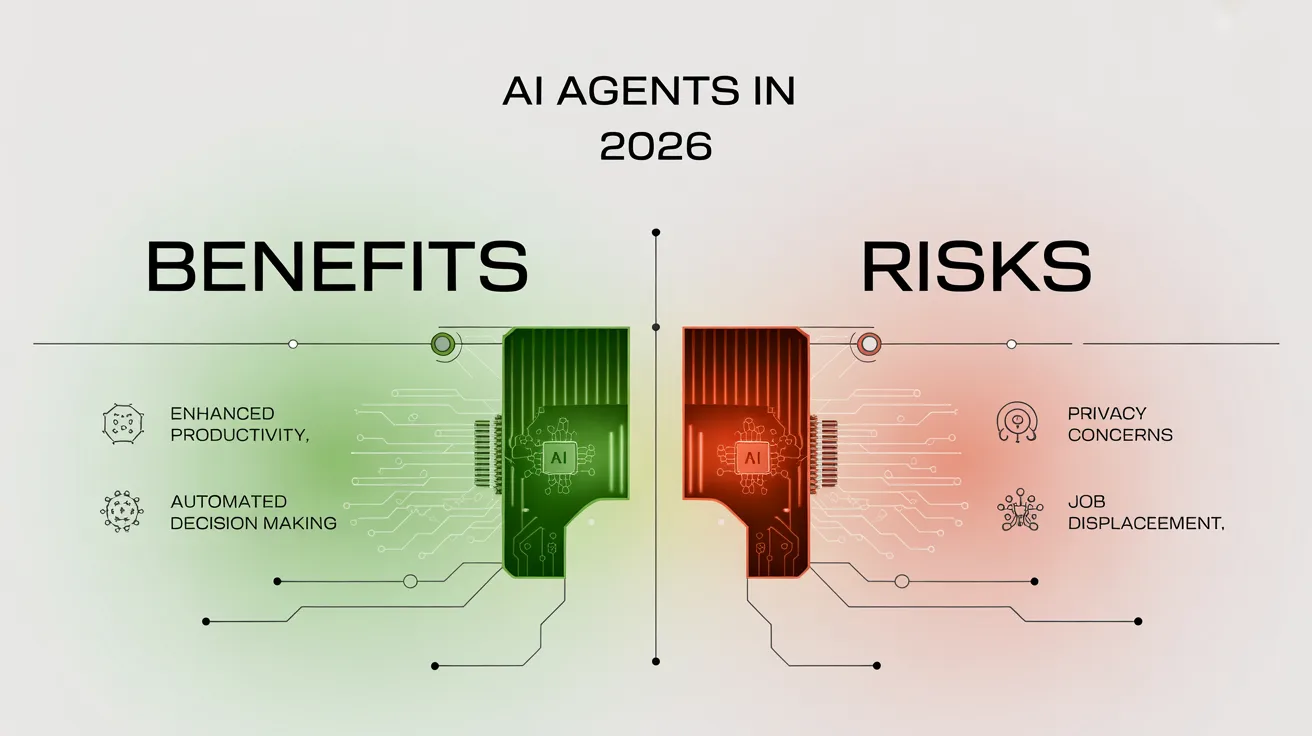
Automation, data-driven guidance, and workflow optimization are driving a transformation across industries through the use of AI agents; however, they are not flawless. This is critical to understanding what is beneficial and what is risky to be adopted strategically.
Important conclusion: The judicious use of AI agents results in a maximum level of efficiency with the reduction of possible traps.
2. Benefits of AI Agents
2.1 Automation at Scale
- Automatic performance of repetitive tasks.
- Minimize human error and time wasted on riotous activities.
Example:
Having 1,000 keywords to work with, an SEO agent can automatically group the keywords, create outlines, and schedule content.
2.2 24/7 Operation
- Always active at work.
- Deal with international business across time.
Example:
AI agents can be deployed by marketing teams to monitor social media, track competitor updates, and analyze data 24/7.
2.3 Faster Decision-Making
- Process huge volumes of data in a few minutes.
- Deliver strategic action.
Example:
Financial agents can analyze stock trends and generate risk reports more quickly than conventional human teams.
2.4 Cost Reduction
- Minimize research, content, and operational labor costs.
- Promote teamwork on the enterprise workflow.
Example:
An A.I.-based startup that conducts SEO research with the help of agents can be as productive as a team of 5 people at a tenth of the cost.
3. Risks of AI Agents
3.1 Accuracy Issues
- Agents are prone to misinterpreting data or making wrong conclusions.
- This requires verification, in particular, critical decisions.
Example:
As long as the data sources are not updated, an AI agent proposing SEO topics will focus on outdated trends.
3.2 Over-Reliance
- Over-reliance on AI may minimise human control and innovation.
- There is still a need to think critically.
Example:
The blind application of AI-generated content clusters, without consideration of intent or audience, can be detrimental to SEO operations.
3.3 Ethical Considerations
- Prejudice on training information can cause uneven or inaccurate results.
- Clear surveillance and a code of conduct are required.
Example:
Scholars working with biased data would have misrepresented trends or lessons in their reports.
3.4 Security Vulnerabilities
- Vulnerability to APIs and databases.
- Mechanisms of cybersecurity are necessary.
Example:
Any agent with API access may inadvertently expose sensitive data if it is not properly secured.
4. Practical Tips for Safe Adoption

- Sources of data should be trusted and updated frequently.
- Integrate AI agent results with human responses.
- Establish specific objectives and constraints for every agent.
- Track actions of the agent to avoid mistakes or partisanship.
5. FAQs
Q1: What are the key advantages of AI agents?
A: The main advantages are automation, 24/7 working, quicker decision-making, and a reduction in costs.
Q2: What are the primary dangers of AI agents??
A: The key threats are accuracy concerns, over-reliance, ethical concerns, and security risks.
Q3: What are some safe practices in deploying AI agents by businesses?
A: Make use of trusted data, integrate with human checks, set specific objectives, and track the behavior of agents in real-time.